
DHT and Prostate Enlargement Explained: Hormones, Prostate Growth and Age-Related Changes
Learn how DHT and prostate enlargement are connected. A research-informed guide explaining hormonal regulation, prostate growth, and age-related prostate changes. The prostate gland plays an important role in the male reproductive system, contributing fluid that supports sperm function and reproductive physiology. Although relatively small in size, the prostate is highly responsive to hormonal signals, particularly androgens such as testosterone and dihydrotestosterone (DHT). Among these hormones, DHT has been widely studied in relation to prostate growth and age-related changes in prostate tissue. Medical research often explores the relationship between DHT and prostate enlargement, especially in connection with benign prostatic hyperplasia (BPH), a common condition that affects many men as they age.
Age-related prostate changes may influence urinary patterns and sometimes contribute to symptoms such as frequent urination in men over 40.
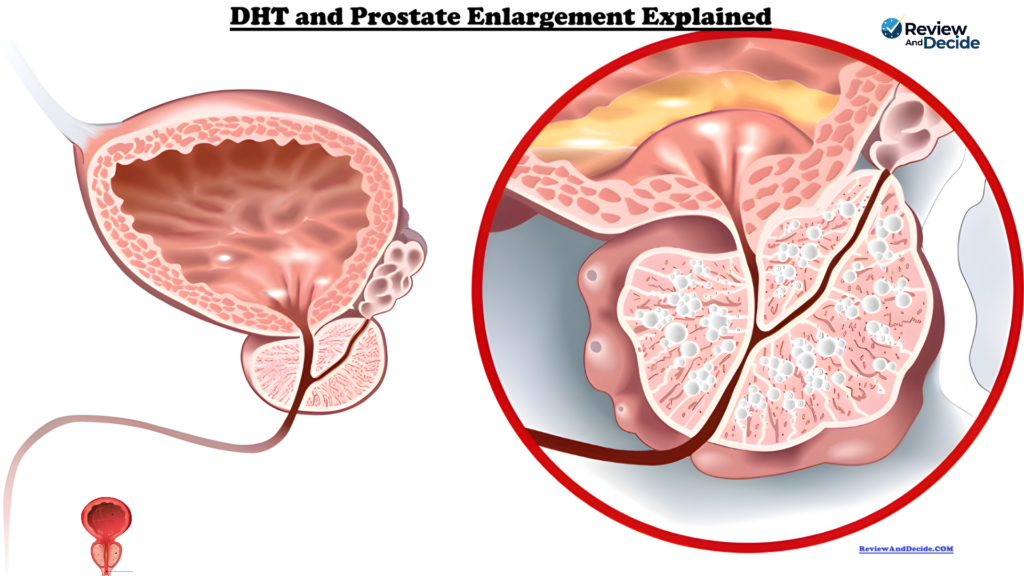
Illustration explaining how DHT may influence prostate enlargement and urinary flow.
Understanding how hormones influence prostate biology helps place age-related changes into context. This article explores the scientific background of DHT, its biological role, and how researchers interpret the relationship between DHT and prostate enlargement.
📜 Policy Declaration
This article is published for educational and informational purposes only. The objective of this content is to explain biological processes, health concepts, and research findings related to prostate anatomy, hormonal regulation, and age-related prostate changes using publicly available scientific information.
We do not provide medical diagnoses, treatment recommendations, or guaranteed health outcomes. The explanations presented in this article are written using neutral and evidence-aware language based on general medical knowledge and research summaries from recognized health institutions.
Our editorial process follows widely accepted standards for responsible health communication, including alignment with Google Helpful Content guidelines, YMYL (Your Money or Your Life) information safety principles, and E-E-A-T standards that emphasize accuracy, transparency, and responsible information sharing.
The purpose of this content is to support general educational understanding of prostate health topics rather than to promote specific medical treatments, products, or clinical outcomes. Individual health responses may vary depending on personal medical history, lifestyle factors, and underlying health conditions.
Readers are encouraged to use this information as general educational guidance and to consult qualified healthcare professionals for personalized medical evaluation or health-related concerns.
What Is Dihydrotestosterone (DHT)?
Dihydrotestosterone, commonly known as DHT, is a hormone derived from testosterone. It belongs to a class of hormones called androgens, which are responsible for the development and maintenance of male physical characteristics.
DHT is produced when testosterone is converted by an enzyme called 5-alpha-reductase. This process occurs in various tissues throughout the body, including the prostate.
Scientific literature describes DHT as a potent androgen, meaning it binds strongly to androgen receptors in certain cells. These receptors are present in many tissues, including:
- prostate tissue
• hair follicles
• skin
• reproductive organs
Because of its strong receptor binding ability, DHT plays an important role in regulating the growth and function of certain androgen-sensitive tissues.
How DHT Is Produced in the Body
The production of DHT begins with testosterone, the primary male sex hormone produced mainly in the testes.
The process generally follows these steps:
- Testosterone circulates through the bloodstream.
- The enzyme 5-alpha-reductase converts testosterone into DHT.
- DHT binds to androgen receptors in specific tissues.
- These receptors activate cellular responses related to growth and function.
Although DHT levels in the bloodstream are typically lower than testosterone levels, DHT’s biological activity is stronger at the tissue level because of its high affinity for androgen receptors.
This hormonal pathway is an important part of male reproductive biology.
Role of DHT in Male Development
DHT plays a critical role during several stages of male development.
Fetal Development
During fetal development, DHT contributes to the formation of male reproductive structures. It helps guide the differentiation of certain tissues in the developing reproductive system.
Puberty
During puberty, rising testosterone levels lead to increased DHT production. This hormonal change contributes to:
- development of male genital structures
• growth of body hair
• maturation of reproductive tissues
DHT also influences the growth of the prostate during adolescence.
Adulthood
In adulthood, DHT continues to support the maintenance of androgen-sensitive tissues, including the prostate.
The Prostate and Hormonal Sensitivity
The prostate gland is considered androgen-dependent, meaning its growth and maintenance rely on hormonal signals.
Androgen receptors present in prostate cells respond to hormones such as:
- testosterone
• dihydrotestosterone (DHT)
Among these hormones, DHT is particularly active within prostate tissue.
Researchers often describe DHT as a key regulator of prostate cell activity because it influences:
- cellular growth
• tissue maintenance
• gene expression within prostate cells
This is why many studies investigating prostate enlargement explore the role of DHT.
Understanding what is the prostate and how the gland functions helps explain why hormonal signals such as DHT influence prostate tissue over time.
Understanding Prostate Enlargement
Prostate enlargement is medically referred to as benign prostatic hyperplasia (BPH).
The term “benign” indicates that the enlargement is non-cancerous.
BPH becomes more common as men age, especially after age 50. Research from organizations such as the National Institute on Aging suggests that prostate growth can gradually occur as part of the aging process.
However, prostate enlargement does not affect all men equally. Some individuals experience noticeable urinary symptoms, while others may have minimal or no symptoms.
Understanding how hormones interact with prostate tissue helps researchers explore why these differences occur.
Medical research frequently explores what causes an enlarged prostate, particularly in relation to hormonal activity and age-related tissue changes.
DHT and Prostate Enlargement
Medical researchers have long investigated the relationship between DHT and prostate enlargement.
Studies often suggest that DHT may influence prostate tissue growth because of its interaction with androgen receptors in the gland.
In many scientific discussions, DHT is considered one of the factors involved in the biological processes associated with BPH.
Researchers propose that DHT may influence:
- prostate cell proliferation
• tissue remodeling
• local hormonal signaling
However, scientific findings are complex, and prostate enlargement is believed to involve multiple biological mechanisms, not just a single hormone.
Hormonal Changes With Age
Hormone levels change gradually as men grow older.
Several patterns have been observed in scientific studies:
- Testosterone levels may slowly decline with age
• DHT levels in certain tissues may remain active
• Hormonal signaling pathways may shift over time
These changes are sometimes discussed in relation to prostate tissue growth, although the exact biological interactions continue to be studied.
Because the prostate is hormonally sensitive, researchers believe age-related hormonal shifts may contribute to changes in prostate structure.
Other Factors That May Influence Prostate Growth
While hormones are important, prostate enlargement is not thought to be caused by hormones alone.
Research suggests that several additional biological factors may play a role.
These include:
- genetic predisposition
• inflammatory processes
• metabolic health factors
• age-related cellular changes
Because of these multiple influences, prostate enlargement is generally considered a multifactorial condition.
Scientific Research on DHT and Prostate Tissue
Medical research institutions continue to study the role of DHT in prostate biology.
Studies often focus on topics such as:
- androgen receptor signaling
• cellular growth patterns in prostate tissue
• hormonal pathways influencing prostate enlargement
Clinical research has helped scientists better understand the biochemical processes that occur within prostate cells.
However, researchers often emphasize that prostate health involves complex interactions between hormones, genetics, and aging biology.
Lifestyle and Hormonal Health Context
Hormonal balance is influenced by many aspects of overall health.
Research institutions such as Harvard Health Publishing often discuss lifestyle factors that may influence hormonal systems, including:
- regular physical activity
• balanced nutrition
• metabolic health
• body weight regulation
These factors are part of broader health patterns that influence many physiological systems.
However, no single lifestyle approach guarantees a specific prostate outcome.
Some individuals also explore products discussed in our prostate support supplement review while learning about hormonal influences on prostate health.
Transparency & Scientific Context
Understanding the relationship between DHT and prostate enlargement requires consideration of multiple biological processes. Medical research describing prostate growth often focuses on hormonal signaling, cellular activity, and age-related tissue changes.
Scientific knowledge in this area has developed through decades of clinical observation and laboratory research conducted by institutions such as the National Institutes of Health (NIH) and academic medical centers.
Current research emphasizes that prostate enlargement is influenced by a combination of hormonal activity, genetic predisposition, and aging biology. While DHT is frequently studied due to its strong interaction with androgen receptors in prostate tissue, it represents only one part of a broader biological system.
Educational discussions of prostate hormones therefore focus on explaining known physiological mechanisms while acknowledging that individual health outcomes may vary.
Evidence-Based Position
This article presents a research-informed overview of hormonal influences on prostate biology. The explanations provided reflect general scientific understanding of androgen function, prostate anatomy, and age-related changes.
Medical literature consistently indicates that the prostate is a hormonally responsive gland and that androgens such as testosterone and DHT play important roles in prostate development and maintenance.
However, scientific research also emphasizes that prostate enlargement and related symptoms are influenced by multiple biological pathways. Hormones represent one part of this complex system.
What Science Consistently Emphasizes
Across major health institutions and clinical research publications, several points about prostate biology are widely recognized.
These include:
- the prostate is influenced by androgen hormones
• DHT binds strongly to androgen receptors in prostate cells
• prostate enlargement becomes more common with age
• not all prostate enlargement produces symptoms
• hormonal signaling interacts with other biological processes
These findings form the basis of many current discussions about prostate health.
Where Supplements Fit (Contextual Clarification)
Dietary supplements and botanical extracts are sometimes discussed in the context of prostate wellness. Some plant-derived compounds have been examined in observational research and clinical studies exploring hormonal pathways and prostate health.
However, supplements should not be interpreted as medical treatments or guaranteed solutions for prostate conditions. Research findings can vary, and individual responses depend on many factors including health status, dosage, and lifestyle.
Educational discussions of supplements are therefore presented only in the context of scientific research and public awareness.
Some research also examines nutritional compounds and ingredients associated with prostate wellness in the context of broader prostate health discussions.
Research Methodology
The educational content in this article was developed using information from widely recognized health institutions, clinical research summaries, and medical education resources.
Sources include:
- National Institutes of Health (NIH)
• National Institute on Aging (NIA)
• Harvard Health Publishing
• Mayo Clinic medical education materials
These sources provide research-based insights into prostate anatomy, hormonal regulation, and age-related changes.
Editorial Transparency Statement
This article is part of an educational health publishing project designed to explain biological processes and research findings related to common health topics.
The information presented is intended for general educational purposes and does not replace medical consultation, diagnosis, or treatment provided by qualified healthcare professionals.
Content is written using a neutral tone and evidence-aware explanations to support responsible health communication.
Evidence Integrity Commitment
We are committed to presenting health information responsibly and transparently.
Our editorial approach includes:
- avoiding exaggerated health claims
• avoiding fabricated research references
• avoiding guaranteed outcomes
• acknowledging scientific uncertainty where it exists
When discussing research findings, language reflects the current level of scientific understanding.
Final Educational Summary
Dihydrotestosterone (DHT) is a hormone derived from testosterone that plays an important role in male reproductive biology. Because prostate tissue contains androgen receptors that respond strongly to DHT, researchers often examine the relationship between DHT and prostate enlargement.
Scientific research suggests that hormonal signaling, including DHT activity, may influence prostate tissue growth over time. However, prostate enlargement is influenced by multiple biological factors including genetics, aging processes, and broader health conditions.
Understanding the hormonal biology of the prostate helps provide context for discussions about prostate health and age-related changes.
Educational Intent Disclaimer
This article is intended for educational and informational purposes only. It summarizes publicly available research related to hormones, prostate biology, and age-related prostate changes.
The information presented should not be interpreted as medical advice, diagnosis, or treatment recommendations.
Frequently Asked Questions (FAQ)
What is DHT?
DHT (dihydrotestosterone) is a hormone derived from testosterone that plays a role in male development and androgen-sensitive tissues.
How is DHT related to prostate enlargement?
Research suggests that DHT interacts with androgen receptors in prostate cells, which may influence prostate tissue growth.
Does everyone experience prostate enlargement with age?
No. Although prostate enlargement becomes more common with age, not all individuals experience symptoms.
Can hormones influence prostate health?
Hormones such as testosterone and DHT play important roles in prostate development and maintenance.
Is prostate enlargement always serious?
Many cases of prostate enlargement are non-cancerous and related to benign prostatic hyperplasia (BPH).
Conclusion
Understanding the relationship between DHT and prostate enlargement helps explain how hormonal signaling influences the biology of the prostate gland. Dihydrotestosterone is a naturally occurring androgen derived from testosterone, and it plays an important role in male reproductive development and tissue maintenance throughout life.
Because prostate cells contain androgen receptors that respond strongly to DHT, researchers have long studied how hormonal activity may influence prostate tissue growth over time. Scientific discussions often examine the connection between DHT, cellular signaling pathways, and age-related changes in prostate structure.
However, medical research also emphasizes that prostate enlargement is a complex process influenced by multiple biological factors. Hormonal activity, genetics, aging processes, and broader metabolic health patterns may all contribute to changes in prostate tissue.
Educational awareness of these mechanisms helps provide context for discussions about prostate health and aging. While hormonal research continues to evolve, understanding how the prostate functions and how hormones interact with prostate tissue can help individuals better interpret scientific information related to prostate biology.
As with any health-related topic, questions about prostate symptoms or hormonal health should always be evaluated by qualified healthcare professionals who can provide appropriate medical guidance and personalized care.
For more research-informed articles exploring prostate anatomy, hormones, and urinary health topics, visit our prostate health research hub.
Medical Disclaimer
The content in this article is not intended to diagnose, treat, cure, or prevent any disease. Individuals experiencing health concerns related to prostate or urinary symptoms should consult qualified healthcare professionals for appropriate evaluation and guidance.
 High-Authority References & Sources