
A Comprehensive Research-Based Guide to Prostate Anatomy, Function, Hormones, and Age-Related Changes
Learn what is the prostate, where it is located, and what it does. A research-based guide explaining prostate function and age-related changes. The prostate is a small gland that forms part of the male reproductive system, yet its biological significance extends beyond what many people realize. Although it is often discussed in connection with aging, urinary symptoms, or men’s health screenings, the prostate is fundamentally a normal anatomical structure that plays a defined physiological role throughout adult life.
According to the National Institutes of Health (NIH), the prostate contributes fluid to semen and functions in coordination with other components of the male reproductive system. This fluid supports sperm mobility and viability. While the gland itself is modest in size — approximately the size of a walnut in younger adult men — its location and hormonal responsiveness make it biologically important.
Understanding the prostate begins not with disease, but with anatomy and physiology. Before discussing age-related changes or research developments, it is essential to understand:
- Where the prostate is located
- How it develops
- What it produces
- How hormones influence it
- Why it changes over time
This article provides an in-depth, research-based overview of the prostate gland using information supported by institutions such as NIH, Mayo Clinic, and Harvard Health Publishing. It is designed for educational purposes and does not provide diagnosis or medical advice.
1. Anatomical Location of the Prostate
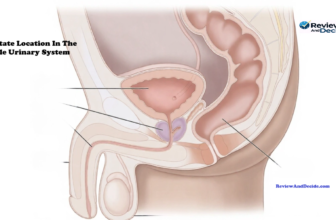
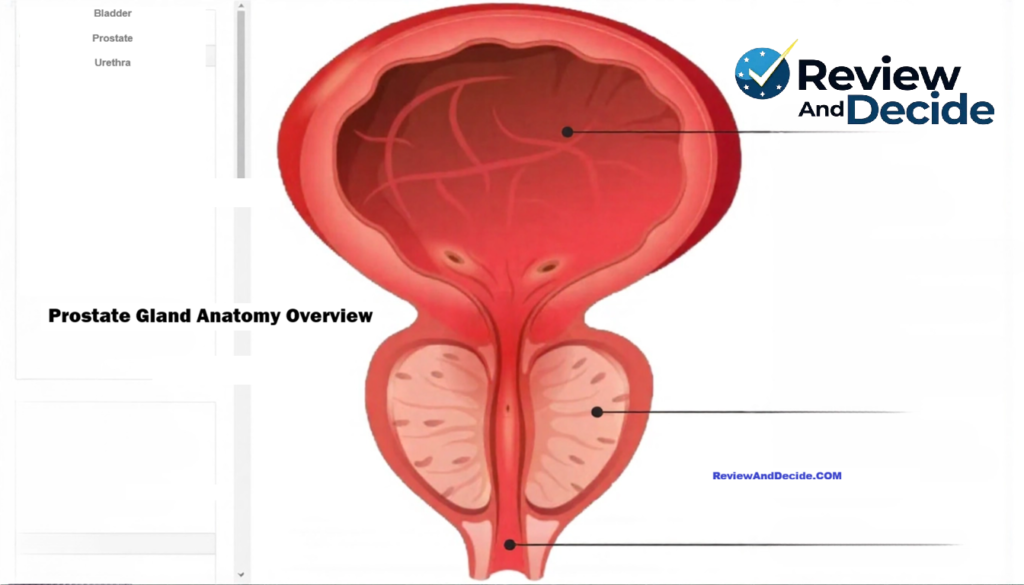
The prostate is situated in the lower pelvis, directly below the bladder and in front of the rectum. It surrounds the upper portion of the urethra — the tube that carries urine from the bladder to the outside of the body.
This anatomical relationship explains why prostate size changes may influence urinary flow. The urethra passes directly through the center of the prostate, which means that any enlargement of the gland may affect the diameter of that passage.
Mayo Clinic describes the prostate as:
- Roughly walnut-sized in younger men
- Composed of glandular and muscular tissue
- Positioned between the bladder and pelvic floor
The prostate is not visible externally and is not a large organ. Its influence is due more to its location and hormonal sensitivity than its size.
2. Structure and Composition of the Prostate
The prostate is composed of:
- Glandular tissue (which produces fluid)
- Smooth muscle fibers
- Connective tissue
The gland is divided into zones:
- Peripheral zone
- Central zone
- Transitional zone
According to research cited by the National Library of Medicine (NLM), these zones have different cellular characteristics and may behave differently over time.
The glandular portion is responsible for producing prostatic fluid. The muscular portion assists in ejaculation by contracting during reproductive activity.
This structural duality — glandular + muscular — explains why the prostate participates in both fluid production and mechanical function.
3. Development of the Prostate Over the Lifespan
Fetal Development
The prostate begins forming during fetal development under the influence of androgens, particularly testosterone. These hormones guide the differentiation of reproductive tissues.
Childhood
During childhood, the prostate remains small and relatively inactive.
Puberty
At puberty, increased testosterone levels stimulate rapid growth of the prostate. Dihydrotestosterone (DHT), a derivative of testosterone, plays a central role in this phase.
Harvard Health Publishing explains that DHT binds to androgen receptors in prostate tissue, influencing growth and development during adolescence.
Early Adulthood
After puberty, prostate size stabilizes for many years.
Midlife and Aging
Beginning in midlife, gradual hormonal changes may influence prostate tissue again. Research suggests that DHT remains biologically active even as testosterone declines with age.
These hormonal interactions are complex and vary between individuals.
4. Primary Functions of the Prostate
The prostate serves several biological functions.
4.1 Production of Prostatic Fluid
The primary role of the prostate is to produce fluid that becomes part of semen. According to NIH descriptions of male reproductive anatomy, prostatic fluid contains:
- Enzymes
- Zinc
- Prostate-specific proteins
- Nutrients
This fluid helps:
- Protect sperm
- Enhance sperm mobility
- Contribute to semen liquefaction
Without prostatic fluid, sperm transport efficiency may be reduced.
research on saw palmetto for prostate support
4.2 Role in Ejaculation
The prostate contains smooth muscle tissue that contracts during ejaculation. This contraction helps propel semen into the urethra.
4.3 Contribution to Fertility
Prostatic fluid contributes to the environment in which sperm function. While sperm originate in the testes, their functional viability is influenced by the fluids produced by accessory glands, including the prostate.
4.4 Indirect Influence on Urinary Flow
Although the prostate does not produce urine, its surrounding position around the urethra means that structural changes may influence urinary dynamics.
5. Hormonal Regulation of the Prostate
Hormones regulate prostate size and function.
Testosterone
Testosterone is essential for the development and maintenance of male reproductive tissues.
Dihydrotestosterone (DHT)
DHT is produced from testosterone by the enzyme 5-alpha-reductase. According to NIH research, DHT binds strongly to androgen receptors in prostate cells.
DHT plays a central role in:
- Pubertal growth
- Tissue maintenance
- Age-related enlargement
However, research findings regarding long-term hormonal influence vary and continue to evolve.
Aging and Hormone Shifts
As men age:
- Testosterone levels gradually decline
- DHT activity remains locally influential
This hormonal pattern is believed to contribute to age-related prostate enlargement.
the role of DHT in prostate enlargement
6. Age-Related Changes in the Prostate
The National Institute on Aging (NIA) reports that prostate enlargement becomes more common after age 50.
This condition is known as benign prostatic hyperplasia (BPH). Importantly:
Benign means non-cancerous.
Not all enlargement causes symptoms, and not all symptoms are caused by enlargement.
Gradual growth of prostate tissue may occur as part of aging biology.
7. Common Misunderstandings About the Prostate
Myth 1: Prostate Enlargement Equals Cancer
According to Mayo Clinic, most prostate enlargement is non-cancerous.
Myth 2: Only Older Men Should Learn About the Prostate
Education benefits men at all stages of adulthood.
Myth 3: Urinary Changes Always Mean Prostate Disease
Urinary patterns can be influenced by:
- Hydration
- Medications
- Infections
- Neurological conditions
Only medical evaluation can determine cause.
8. Current Research Areas
Research institutions such as NIH and Harvard Medical School continue to study:
- Hormonal influence
- Inflammatory pathways
- Genetic risk factors
- Metabolic health connections
Research often describes associations rather than guaranteed outcomes.
9. Lifestyle and Broader Health Context
Harvard Health Publishing discusses how:
- Metabolic health
- Physical activity
- Balanced diet
- Weight management
May influence hormonal balance and systemic inflammation.
However, no single lifestyle factor guarantees a specific prostate outcome.
10. Prostate and Systemic Health
The prostate does not function in isolation. It is influenced by:
- Cardiovascular health
- Hormonal regulation
- Immune function
- Inflammatory processes
Systemic health patterns influence multiple organs, including the prostate.
11. When Professional Evaluation Is Appropriate
Persistent symptoms such as:
- Difficulty urinating
- Pain
- Blood in urine
Should be evaluated by a qualified healthcare professional.
Only medical professionals can provide testing and diagnosis.
This article provides general educational information and is not a substitute for professional medical advice.
Conclusion
The prostate is a small but biologically significant gland within the male reproductive system. It produces fluid essential for semen composition, responds to hormonal signals throughout life, and undergoes natural changes with aging.
Research from the National Institutes of Health, Mayo Clinic, and Harvard Health Publishing continues to expand understanding of prostate biology. While age-related changes are common, education and awareness provide clarity without unnecessary alarm.
Understanding what the prostate is and what it does empowers informed discussions with healthcare providers and supports a balanced, research-based perspective on men’s health.
Frequently Asked Questions (FAQ)
What is the main function of the prostate?
The prostate primarily produces fluid that becomes part of semen. This fluid supports sperm mobility and reproductive function.
Where is the prostate located in the body?
The prostate is located just below the bladder and surrounds part of the urethra, which carries urine out of the body.
Does the prostate change with age?
Research indicates that the prostate may gradually enlarge as men age, which is a common biological change.
Is prostate enlargement always a sign of cancer?
No. According to medical sources such as Mayo Clinic, most prostate enlargement is non-cancerous and often related to aging.
When should someone consult a healthcare
professional about prostate concerns?
Persistent urinary changes or discomfort should be evaluated by a qualified healthcare professional for proper assessment.
Medical & Educational Disclaimer
This article is provided for informational and educational purposes only. It is not intended to diagnose, treat, cure, or prevent any medical condition. The information presented is based on publicly available research and reputable health sources. Individuals experiencing health concerns should consult a qualified healthcare professional for personalized medical advice.
📚 High-Authority References
- National Institutes of Health (NIH) – Prostate Gland Overview
- National Library of Medicine (MedlinePlus) – Prostate Health
- National Institute on Aging – Prostate Changes with Age
- Mayo Clinic – Prostate Gland and Enlargement
- Harvard Health Publishing – Prostate Health Insights