
Palworld Breeding
Calculator & Planner
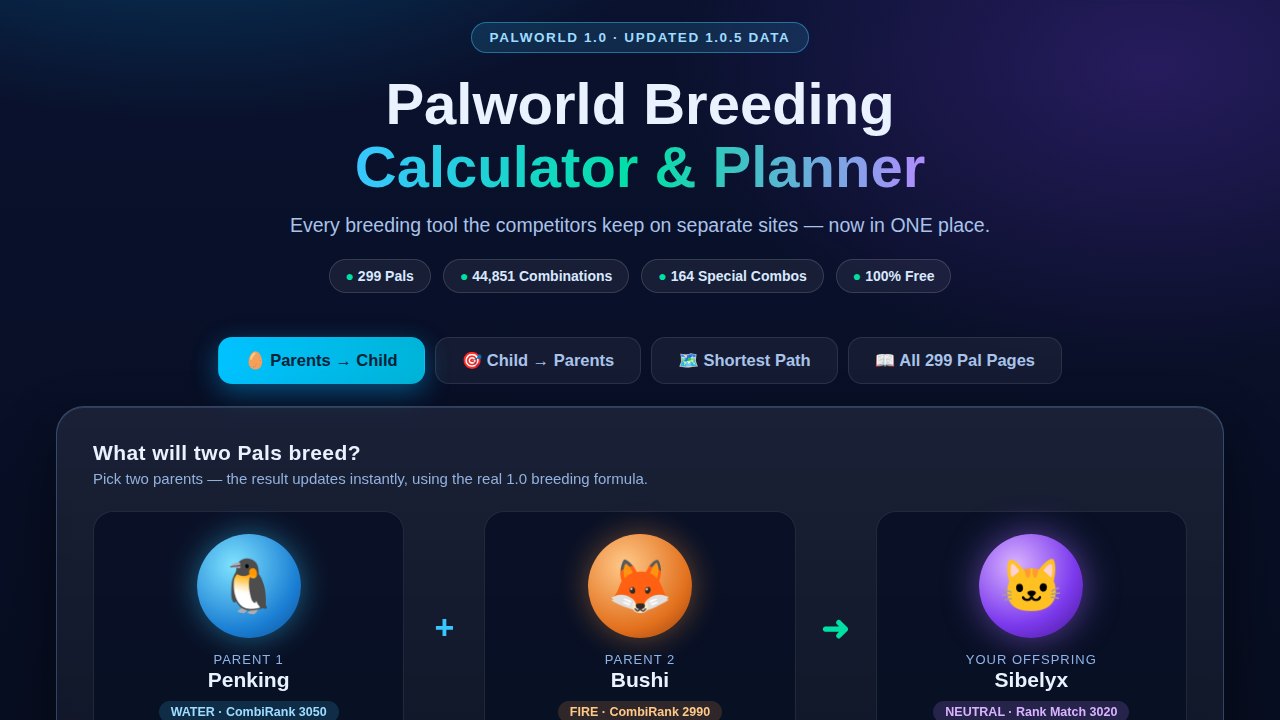
Every breeding tool the other sites split across separate pages — forward lookup, reverse lookup, shortest-path planner and the full Pal directory — in one place, checked against the real Palworld 1.0 breeding data for all 299 Pals and all 44,850 parent pairs.
What will two Pals breed?
Pick two parent Pals below. The offspring appears instantly — no guessing, because every pair is looked up in the extracted Palworld 1.0 breeding table.
This Palworld breeding calculator does something most breeding tools do not: instead of estimating results with a rough formula, it checks your pair against the complete Palworld 1.0 breeding table — all 44,850 possible parent pairs across all 299 Pals. Breeding changed a lot when Palworld 1.0 launched, and many older charts still show Early Access results that are simply wrong today. The famous example is Penking + Bushi: before 1.0 that pair produced Anubis, but in the current game it produces Sibelyx. If a calculator still tells you Anubis, its data is out of date. Every result on this page comes from the current 1.0 data, including the newest Pals and variants, so the egg you plan for is the egg you actually get.
How Breeding Works in Palworld 1.0
Breeding starts at the Breeding Farm, which unlocks at Technology Level 19. Assign one male and one female Pal to the farm, put a Cake in the farm’s chest, and the pair produces an egg. Move the egg to an Egg Incubator and wait for it to hatch. Any two species can be paired — the parents do not need to match — and the species of the child is fixed by the game’s breeding table, never random. Behind the table sits a hidden value players call CombiRank (also known as breeding power): common Pals carry high values and rare Pals carry low ones, and most ordinary results follow the average of the two parents’ values. But the table also contains fixed outcomes the simple average cannot predict, which is exactly why this calculator uses the full table instead of the shortcut formula. Two details matter in practice. First, some Pals can only be bred from two of their own species — Faleris is the famous example — so no cross-pair will ever produce them. Second, one pair in the game is gender-dependent: a female Katress with a male Wixen produces Katress Ignis, while a male Katress with a female Wixen produces Wixen Noct. This calculator flags that pair automatically. Passive skills, IVs and mutations are rolled separately when the egg hatches, so this tool predicts the species only — bring parents with the passives you want to pass down.
Using the Parents to Child Calculator
The forward calculator is the tool you will use most. Type the name of your first parent, pick it from the list, do the same for the second parent, and the offspring card updates instantly with the child’s name, its Paldeck number and how many total combinations can produce it. Use it before you spend a single Cake: it settles arguments about changed 1.0 combinations in seconds, and it is the fastest way to check whether the two Pals already standing in your base can make the Pal you are missing. Because the lookup runs entirely in your browser from the embedded 1.0 table, there is no sign-up, no waiting and no limit on how many pairs you test.
Using the Child to Parents Reverse Lookup
The reverse lookup answers the opposite question: you know the Pal you want, so which parents make it? Select a target and the tool lists every parent combination that produces it — for popular targets like Anubis that means hundreds of working pairs, not just one recipe copied from a chart. Scan the list for Pals you already own, or use the filter box to show only pairs that include a specific Pal you have caught. This is where most players save the most time, because the cheapest route to a rare Pal is almost always a pair of common Pals already sitting in the Palbox rather than a long chain of intermediate breeds.
Using the Shortest Path Breeding Planner
Sometimes no single pair you own can make your target, and that is what the planner is for. Add up to twenty Pals from your Palbox, choose your target, and the planner searches breeding chains up to four generations deep to find the shortest route: which pair to breed first, what that produces, and which pair to breed next until the target hatches. Each step is shown as its own card with the exact parents and result, so you can follow it in-game one egg at a time. If the target cannot be reached within four steps from your current Pals, the planner tells you honestly instead of inventing a route — catching one or two more common Pals usually unlocks it.
The 299 Pal Breeding Directory
The directory tab lists every breedable Pal in Palworld 1.0 with its Paldeck number, its CombiRank and the exact number of parent combinations that produce it. It is the quickest way to judge how hard a Pal is to breed: a Pal with hundreds of combinations is easy to reach from almost any roster, while a Pal with a single combination — its own species — has to be caught or bred from itself. Selecting any Pal in the directory jumps to its full combination list in the reverse lookup, so research and planning stay one click apart.
Palworld Breeding Tips That Save You Cakes
Plan backwards from the target: check the reverse lookup first, because a direct pair you already own beats a four-step chain every time. Keep your breeding pairs fed and the Cake supply steady — a stalled farm wastes more time than any single hatch. Remember that species is the only guaranteed outcome; passives and IVs are inherited by chance, so breed in batches when you are chasing a perfect Pal rather than hatching one egg and hoping. Watch for the breed-true Pals: legendaries such as Faleris, Orserk and Shadowbeak cannot be cross-bred in 1.0, so do not burn Cakes trying. And when a combination you remember from Early Access gives a different egg, trust the 1.0 table — the rebalance changed many classic recipes, including Penking + Bushi.
Frequently Asked Questions
Is this Palworld breeding calculator updated for the 1.0 release?
Yes. Every result comes from the extracted Palworld 1.0 breeding table covering all 299 Pals and all 44,850 parent pairs, including the combinations that changed in the 1.0 rebalance. If an older chart disagrees with a result here, the older chart is showing Early Access data.
How does the calculator know what two Pals will breed?
The child’s species is fixed by the game’s own breeding table. This tool embeds that complete table and looks your exact pair up in it, instead of estimating with the CombiRank averaging shortcut, which cannot reproduce the table’s fixed special outcomes such as Relaxaurus + Sparkit producing Relaxaurus Lux.
Which Pals can only be bred from their own species?
A number of rare Pals — including Faleris and several other legendaries and variants — are produced only by pairing two of the same species. The reverse lookup shows this honestly: their combination list contains a single pair, themselves.
Does the calculator predict passive skills or IVs?
No. It predicts the species of the offspring, which is the part fixed by the breeding table. Passive skills, IVs and mutations are determined by inheritance chances when the egg hatches, so choose parents that already carry the passives you want.
What is the Katress and Wixen gender rule?
It is the one gender-dependent pair in Palworld 1.0. A female Katress bred with a male Wixen produces Katress Ignis, while a male Katress bred with a female Wixen produces Wixen Noct. The calculator flags this pair and shows both outcomes whenever you select it.
Palworld Breeding Guides
- What Do Two Pals Breed in Palworld? How to Check Any Pair Instantly
- How to Find Every Parent Combination for a Pal in Palworld
- Palworld Breeding Chain Planner: The Shortest Route to Any Pal
- All 299 Pals in Palworld 1.0: Breeding Combinations and CombiRank Explained
- Palworld Special Breeding Combos: Fixed Pairs and the Katress × Wixen Gender Rule
- Palworld Breeding Guide 1.0: Farms, Cake, Eggs and Planning Your Breeds
References
- PalCalc — open-source Palworld breeding solver and dataset (MIT)
- Palworld Wiki — Breeding mechanics
- Pocketpair — Palworld official site
Disclaimer: This is an independent, fan-made tool for planning purposes. Breeding data reflects Palworld 1.0 as extracted by the community PalCalc project; game updates may change combinations, and Pocketpair may revise breeding in future patches. This site is not affiliated with or endorsed by Pocketpair. Always verify important plans against the current game version before spending rare resources.