
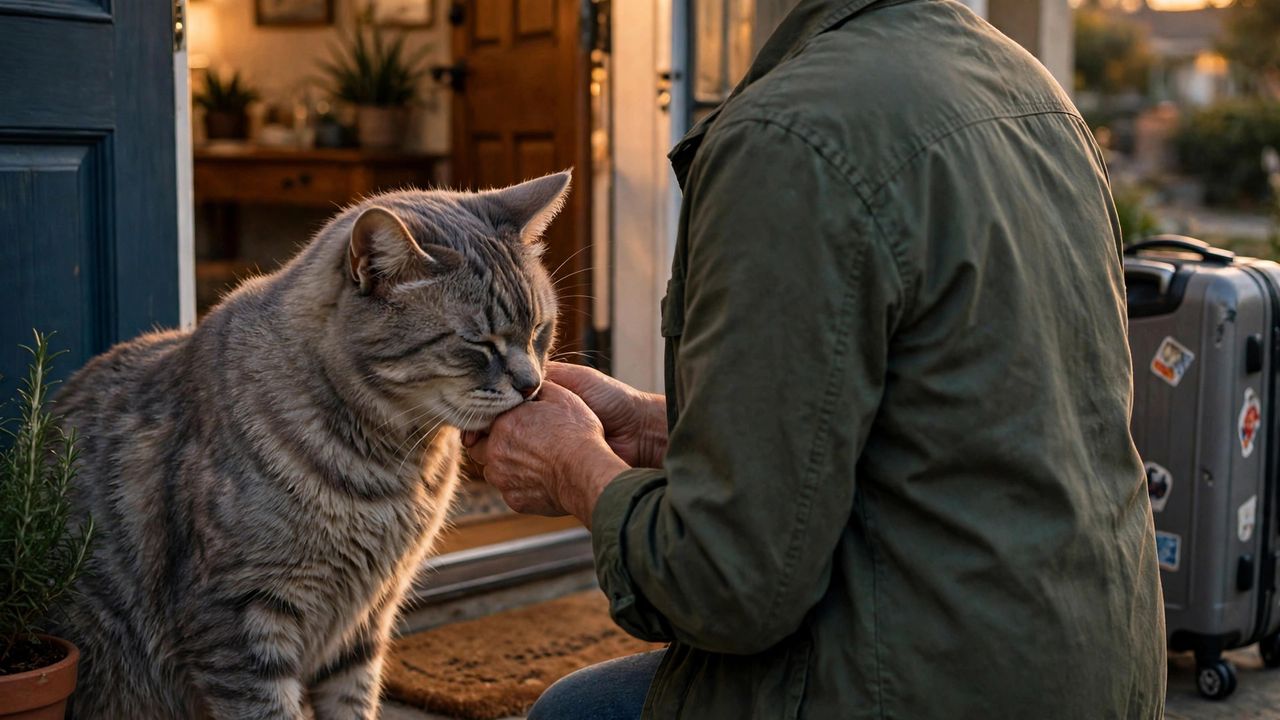
She does not run to the door. Cats rarely do. She simply appears — silently, the way she always did — at the end of the hallway, and she stops. One paw raised. Eyes wide. A whole lifetime, and then years of absence, held in one long, still look. The person in the doorway has an older face, a different coat, a suitcase covered in the dust of other places. Everything has changed. And then she takes one slow step forward, lowers her head, and presses it hard against the hand she has not touched in years — as if to say: I know. I always knew.
If you have ever had to leave a cat — for work, for family, for a life that pulled you to another city or another country — you have asked the question that lives underneath this story: do cats remember their owners after years? Not days. Not a holiday. Years. Does the cat who slept on your chest, who learned the sound of your step and the smell of your clothes, still carry you somewhere inside her when the seasons have turned and turned again? This is her story — the story of the cat at the window — and the honest answer science and experience give is more beautiful than most of us dare to hope.
The images in this story are AI-generated illustrations, shared to honour a scene that plays out in real homes whenever a long separation finally ends.
The Window Seat: Where a Cat Keeps Her Waiting
Every cat who loves a person has a place. Not the expensive bed, usually. A window seat where the afternoon sun lands. The end of the sofa closest to the door. The top of the stairs, from where the whole house can be watched at once. From that place, she learned you — not the way a person learns, with names and photographs, but in the deeper alphabet cats actually use: scent, sound, rhythm.
She knew the exact note of your car among all the cars on the street. She knew your step on the path from every other step, and she knew what the turning of your key meant in the small, complete world of her day. She knew the smell of your hands after work, the sound your voice makes when you are tired, the shape of the evening when you were home and the different, emptier shape of the evening when you were not. Cats are often called independent. Anyone who has watched a cat choose the same lap, at the same hour, every evening for ten years knows better. She was not dependent. She was devoted — on her own quiet terms.
Then one day the suitcase came out. Cats read change long before we announce it: boxes, emptied shelves, furniture in the wrong places, a tension in the voices they love. And then the door closed on a different kind of silence — not the daytime silence that ends at six o’clock, but a silence that stayed. The person who stayed behind fed her, and she ate. But owners tell the same detail in a hundred different words: for a long time afterwards, at the old hour, she still went to the window. She still listened for a car that was not coming. If that is not memory, it is something so close to it that the difference hardly matters.
Do Cats Remember Their Owners After Years? What Is Happening Inside That Stillness
Vets and feline behaviour specialists are careful people, and they do not promise that a cat remembers the way a human remembers — with pictures and stories and dates. But what they describe is, in its own way, stronger. A cat’s memory is built from the senses that rule her world, and those memories are made to last.
It is scent first — always scent. A cat’s sense of smell is far more powerful than ours, and scent is how she files the important beings of her life. Your smell is not a detail to her; it is your identity, written in a language she reads instantly and forgets slowly. This is why the true moment in a reunion is rarely the first look. It is the first sniff — the long, careful investigation of a hand, a sleeve, a suitcase — and then the change that runs through her body when the file opens and the page is still there: known. Safe. Mine.
It is voice. Research on cat cognition has shown that cats can distinguish their owner’s voice from a stranger’s voice. Many owners see the proof without any laboratory: ears turning at a phone speaker, a cat answering a familiar call from another room. A voice she loved is not noise to a cat. It is a landmark.
It is routine, remembered in the body. Cats are creatures of pattern, and patterns built with a person — the morning greeting, the evening game, the exact place a hand should land — are stored as habits of trust. Reunited cats often slip back into an old routine with startling speed, as if the years were a door that simply closed and opened again.
And it is feeling. Specialists describe a cat’s long-term memory as strongly tied to emotion: what kept her safe, what fed her, what she loved. A person who fed her, sheltered her and never hurt her is not filed as a passing event. That person is filed as home. Time can layer dust over it, but for many cats, one familiar scent brings it all back.
The Years Between: How a Cat Ages While She Waits
Here is the part of this story that asks something of us. While the person was away building a life, the cat was living hers at cat speed — and cat speed is faster than ours. A cat who was a bright five-year-old when the door closed can be a grey-muzzled senior when it opens again: slower on the stairs, deeper in her sleep, choosier about her food, thinner along the spine beneath a coat that is still soft. In human terms, those few years apart can mean decades. That is why it helps, before any reunion, to understand honestly where in life your cat now stands — our free Cat Age Calculator converts your cat’s age into human years and shows her life stage, so the person who returns can offer a senior cat the gentler greeting, the softer bed and the more patient pace she now deserves.
And yet age does not seem to file the memory away. The old cat who can no longer jump to the window still turns her head at the voice. The deaf cat still knows the hand by smell alone. The body slows. The bond, apparently, does not — and you can see what it costs her to rise and cross the room, and she comes anyway.
Why Some Reunions Look Quiet at First
Honesty matters here too, because not every reunion looks like the end of a film, and a quiet first hour does not mean a forgotten person. Cats do not greet the way dogs greet. A dog’s love explodes; a cat’s love approaches — slowly, sideways, with pauses to assess. A cat meeting her person after years may watch from a doorway for a long time. She may sniff and then retreat. She may hide, and come out only when the house is calm and the visitor is sitting still, being unthreatening, smelling right.
There are kind reasons for caution. The returning person carries new smells — other animals, other places. The cat may have built a new attachment to the person who cared for her, and cats do not simply discard one loyalty for another. Pain, poor eyesight and the confusion some very old cats develop can also slow things down. None of this is rejection. It is a cat checking whether the world is safe — and the person who loves her lets her take every minute she needs.
How to Rebuild the Bond After Years Apart
If you are the one coming home — or the one bringing a cat back into your life after a long separation — the reunion is not a single moment. It is a gentle campaign of days. These are the things that work, in the order a cat would ask for them.
- Let her come to you. Sit on the floor, side-on, and let her approach, sniff and rub in her own order. Reaching, grabbing and looming undo in seconds what patience builds in minutes.
- Offer your scent before your hands. A worn item of your clothing near her bed lets her study you safely while you are not even in the room — many reunions truly begin overnight, on a familiar-smelling jumper.
- Speak in the old voice. Use the name, the tone and the small everyday phrases she used to hear. Voice is a landmark; give her time to navigate by it.
- Feed something wonderful. Food is memory’s oldest language. A favourite meal, offered calmly by your hand or near your feet, rebuilds the oldest association of all: this person means good things.
- Restore one old routine at a time. The evening game, the morning greeting, the shared quiet hour — bring back the patterns she once trusted, and let new ones grow around them slowly.
- Protect her new bonds too. Thank, respect and keep the person who cared for her in her life where possible. A cat asked to choose between two loves is a cat under stress; a cat allowed to keep both is a cat who can relax.
- Book a gentle vet check. After years apart, an older cat deserves a health review — teeth, kidneys, thyroid, joints and weight — because comfort is the foundation every rebuilt bond stands on.
Most owners who do this patiently tell the same ending. One evening there is a weight on the bed that was not there the night before. A cat, curled in the exact place she used to sleep, against the person she used to sleep against — as if she had only been waiting for the house to be itself again.
So, do cats remember their owners after years? Ask the cat at the window, who kept the appointment long after anyone expected her to. Ask the old cat who crossed a room on stiff legs because a smell reached her that no year had managed to fade. She may not remember your face the way you remember hers. She remembers something older and, in her world, truer: your scent, your voice, your hands, and the feeling of being safe because you existed. Who agrees a cat who still knows you after all those years never really said goodbye at all?
Frequently Asked Questions
Do cats remember their owners after years?
For many cats, yes. A cat’s memory is built on scent, voice, routine and feeling rather than pictures and dates, and those memories can last for years. A returning owner may be recognised at the first sniff or the first familiar word, even if the cat needs time and quiet before she shows what she knows.
How do cats recognise a person after a long time apart?
Mainly by smell, supported by voice and routine. A cat’s sense of smell is far stronger than a human’s, and your scent is your identity to her. Cats can also distinguish their owner’s voice from a stranger’s, and old routines — greetings, games, feeding patterns — often return quickly once trust is re-established.
Why does my cat hide from me after I return home?
Hiding at first is usually caution, not rejection. You may carry new smells, the house may feel different, and cats process change slowly. Sit calmly, let her approach in her own time, offer a worn item of your clothing near her bed, and let food and routine rebuild the bond over days.
Do cats forget their owners if they get a new home?
Cats can form strong new attachments in a new home, and that is a good and healthy thing — but a new bond does not necessarily erase an old one. Many rehomed cats still recognise a previous owner’s scent and voice on meeting again, even after years, though each cat’s response is individual.
Do older cats remember people as well as young cats?
Often, yes — recognition by scent can remain strong in old age, even when eyesight or hearing fade. Some very old cats develop cognitive changes that can make them confused or slower to respond, so a gentle vet check is worthwhile for any senior cat whose behaviour changes noticeably.
How can I help my cat remember and trust me after time apart?
Let her set the pace: sit low and side-on, offer your scent on worn clothing, use her name and your old everyday phrases, feed a favourite meal calmly, and restore one familiar routine at a time. Never punish hiding or hesitation — patience in the first days is what turns recognition back into trust.
References
- Cornell Feline Health Center — research-based guidance on feline behaviour, ageing and health.
- International Cat Care — veterinary and welfare charity guidance on cat behaviour, bonding and elderly cat care.
- American Veterinary Medical Association (AVMA) — Pet Care Resources — responsible cat ownership and everyday care guidance for owners.
- Merck Veterinary Manual — veterinary reference on cat behaviour, ageing and health management.
Keep Reading on Review And Decide
- Cat Care: Complete Guide for Cat Owners — our pillar guide to feeding, health, play, grooming and understanding the cat who shares your life.
- Cat Age Calculator — see your cat’s age in human years and understand the life stage behind her slower, deeper greeting.
- Cat Years to Human Years Converter — convert ages both ways with the full chart, and see how fast a cat’s years really move beside ours.
Disclaimer: This story and guide are for general education and emotional reflection only and are not a substitute for professional veterinary or behaviour advice. Every cat is an individual — if you are worried about your cat’s behaviour, memory, ageing or health, please consult a qualified veterinarian or certified feline behaviourist who can assess your cat in person.