
The key has barely turned in the lock when it starts. A thin, trembling whine from the other side of the door — rising, breaking, rising again — as if the whole day had been held inside one small chest and could finally be let out. By the time the door opens, he is there: body shaking, tail sweeping the floor, crying like his heart might burst, just because you came home.
If you have ever stood in that doorway, shopping bags forgotten in your hands, you already know this is not just a noise. It is the sound of a whole day of waiting ending at once. So why do dogs cry when you come home — and what is that welcome really telling you? This is the story of the dog at the door, the one in home after home, in street after street, who has made waiting into a way of life. His story holds the answer.
The images in this story are AI-generated illustrations, shared to honour a scene that plays out in millions of real homes every single evening.
The Wait Begins Long Before the Key Turns
His day does not start when yours ends. It starts the moment the door closes behind you in the morning. Dogs live by rhythm far more than by clocks, but the rhythm is so precise it can look like a clock: the light shifting across the hallway, the school bus passing, the neighbour’s car, the particular quiet of the late afternoon. Somewhere inside that pattern, an older dog learns the exact neighbourhood of sounds that means soon.
So he takes up his post. Not by the window, not on the soft bed you bought him — by the door. On the worn rug where your smell is strongest, where your shoes live, where the last thing he saw of you disappeared. Young dogs pace and patrol. Old dogs simply lie down and listen, ears turning like small satellites toward every footstep in the corridor, every engine slowing outside, dismissing each one that is not yours with a patience that would humble most humans.
Think about what that means. For a dog, you are not a part of the day. You are the day. The walk, the meal, the voice, the hand on the head — everything good is scheduled around a person who keeps leaving through a door the dog cannot open. And still, he does not hold it against you. He just waits, and when the wait finally ends, all of it comes out of him at once — as a cry.
Why Do Dogs Cry When You Come Home? What Is Happening Inside That Sound
Vets and behaviour specialists describe that homecoming cry as a greeting overflowing its banks, and several honest, ordinary things feed into it at the same time.
It is attachment, spoken out loud. Dogs form deep social bonds with their people, and whining is one of the oldest tools in the dog’s communication kit — puppies whine to call their mother, and adult dogs keep the sound for the beings they depend on most. A dog crying at your return is, in the simplest sense, calling across the last few feet of a separation that felt far longer to him than it did to you.
It is relief. However calm the day looked, some part of your dog was keeping watch with an unanswered question: is he coming back? Your key in the lock answers it. The whine, the spinning, the toy rushed to you as an offering — much of it is tension leaving the body, joy and relief arriving in the same breath.
It is routine recognising itself. Dogs are superb readers of sequences. The engine note of your car, your step on the stair, the pause while you find your keys — by the time the lock turns, your dog has often been emotionally celebrating for a full minute already. The cry at the door is the end of a crescendo that started out on the street.
And sometimes, it is simply who he is. Some breeds and some individual dogs are more vocal greeters than others, just as some people cry at weddings. A happy cry — loose body, soft eyes, wagging tail, a dog who settles within a few minutes — is not a problem to fix. It is a personality to be grateful for.
The Old Dog Who Still Drags Himself to the Door
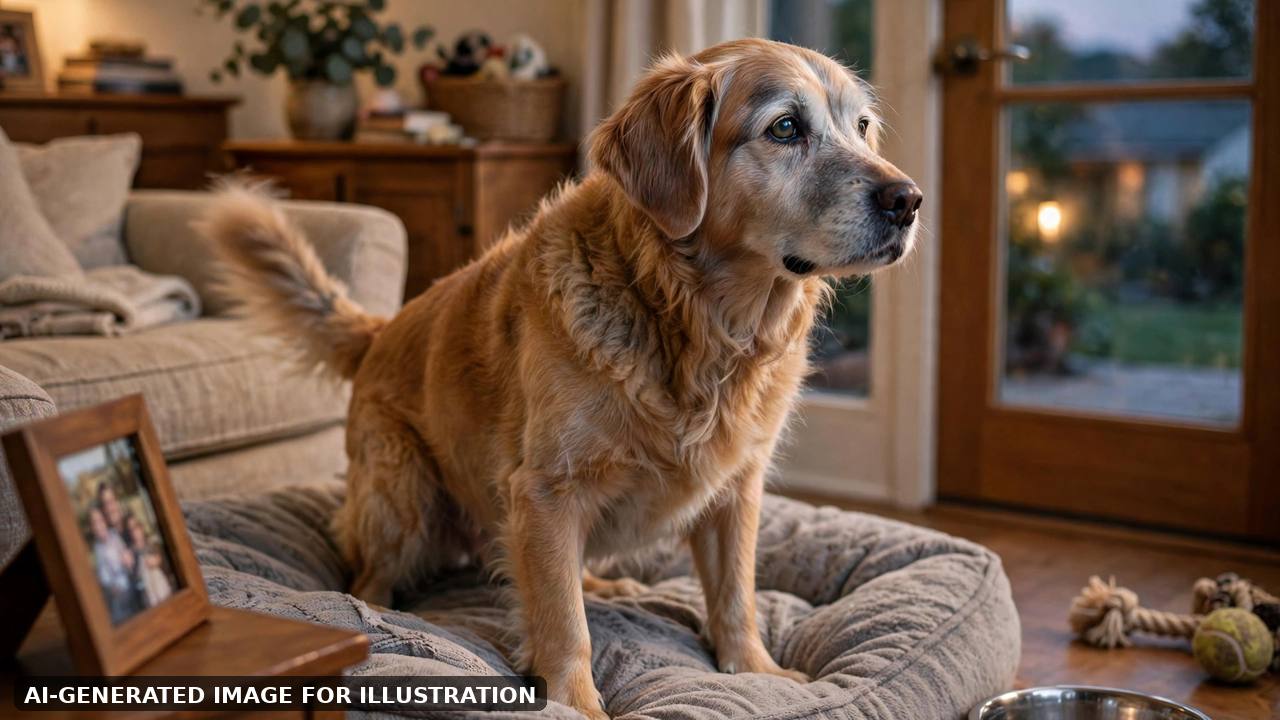
Here is where his story turns, and where most owners quietly feel their throat tighten. The years pass. The muzzle greys. The stairs become a negotiation. The dog who once launched himself at the door like a firework now has to gather himself first — front paws, a pause, back legs, a small shake to settle the hips — before he can begin the long, slow walk down the hallway.
He still comes. That is the whole point. Arthritis can slow a dog, weak eyes can cloud, sleep can deepen until the house feels very far away — but the sound of that key still reaches through all of it. Owners of senior dogs tell the same story in a hundred different words: he can barely manage the garden any more, but he has never once missed the door. The cry is softer now, more tremble than music. It says the same thing it always said, only now you can hear the effort inside it, and the effort is the love letter.
If your greeter is an old friend, a few kind adjustments honour what he is doing for you. Meet him more than halfway — go to him, crouch down to his level, and let the greeting happen where he stands instead of asking his joints to cross the whole house. Keep his route to the door clear and slip-free with runners or mats. And keep up twice-yearly vet checks for senior dogs, because pain is the thief that most often steals a dog’s greetings — and pain, very often, can be eased. A dog who suddenly stops coming to the door is not being distant. He is telling you something, and he deserves to be heard by a vet.
When the Crying Is Not Joy: Separation Anxiety
Honesty matters in a story like this, so here is the harder chapter. For some dogs, the cry at the door is not the end of a peaceful wait — it is the release after hours of genuine distress. Separation anxiety is a real, recognised condition, and its crying sounds similar at the door while meaning something very different during the day.
Watch for the pattern, not the single moment. Warning signs include crying, barking or howling that neighbours report goes on while you are out; destruction aimed at doors, frames and windows — the escape routes; pacing, drooling or panting that starts the moment you pick up your keys; toileting indoors by a dog who is fully housetrained; and a greeting so frantic, for so long, that the dog cannot settle at all. A small camera or a phone recording while you are out can show you which story is yours — the patient wait, or the panic.
If it is panic, please hear this clearly: he is not naughty, and he is not punishing you. He is frightened, and frightened dogs are helped with patience, not scolding. Keep arrivals and departures deliberately low-key for a while — coat on and off without leaving, keys picked up and put down — so the signals lose their charge. Leave a worn item of clothing that smells of you. And build his reserves while you are home: a dog who has genuinely exercised his body and brain settles far more calmly than a dog vibrating with unused energy, which is why working out the right daily activity target matters — our free Dog Exercise Calculator helps you estimate a sensible amount for your dog’s age, size and breed type before you build a calmer leaving routine around it. For anything beyond mild unease, work with your veterinarian or a qualified behaviourist; proper desensitisation programmes genuinely change these dogs’ lives, and medication can help in the harder cases. No dog should have to spend his days in fear of an empty house.
How to Make Every Homecoming Kinder
You cannot stop a loving dog from feeling that cry rise in his chest — and most of us, if we are honest, would never want to. But you can shape homecomings so the joy stays joy, for both of you.
- Greet calmly, then warmly. A quiet hello first, shoes off, coat down — then get on the floor and give him the welcome he has been rehearsing all day. He gets the love; it just arrives without chaos.
- Never punish the cry. Whining at the door is communication, not disobedience. Punishing it teaches a dog that your return is unpredictable — the fastest way to turn joy into anxiety.
- Keep departures boring. No long emotional farewells at the door. A settled routine — walk, water, a safe chew or puzzle feeder, a calm “see you soon” — tells his nervous system the day is ordinary and safe.
- Feed the wait with rest, not emptiness. A comfortable bed near (but not blocking) his waiting spot, a radio on low, daylight where possible — small mercies that make the hours kinder.
- Come back when you say you will. Dogs cannot read clocks, but they read patterns beautifully. A life that returns on rhythm is a life a dog can rest inside.
And one more thing, the thing this whole story has really been about. One day — not today, not soon, but one day — the hallway will be quieter than it used to be. The rug by the door will hold its shape a little longer in the morning. Every owner who has lived long enough with a dog knows that the wait at the door runs in both directions, and that in the end it is we who are left listening for a sound that no longer comes.
So while the cry still greets you, receive it for what it is: the purest sentence in the only language he has. I waited. You came back. Everything is right again. Who agrees every dog deserves a human who always comes back?
Frequently Asked Questions
Why does my dog cry when I come home?
Most homecoming crying is an emotional greeting: attachment, relief and excitement arriving all at once after hours of waiting. Dogs read the whole sequence — your car, your footsteps, your key in the lock — so by the time the door opens, the feeling overflows as a whine, often with a wagging tail, a loose, wriggly body and a toy offered as a gift.
Is it normal for a dog to whine every time I walk in?
Yes, for many dogs it is completely normal and healthy, especially in vocal breeds and in dogs with a strong bond to one person. A happy greeter settles within a few minutes. What matters is the pattern across the whole day, not the whine itself.
How can I tell if the crying is happiness or separation anxiety?
Look at what happens while you are out, not just at the door. Separation anxiety usually brings ongoing barking or howling during your absence, destruction at doors and windows, pacing, drooling, indoor toileting by a housetrained dog, and a greeting so frantic the dog cannot calm down. A camera or audio recording while you are away gives the clearest answer, and your veterinarian can help from there.
Should I ignore my dog when I first come home?
Not completely — cold ignoring can confuse a dog whose only crime is loving you. A kinder method is a calm greeting first: a quiet hello, put your things down, then give warm attention once the first wave of excitement passes. You are rewarding the settling, not withholding the love.
Why does my older dog cry more when I return?
Senior dogs often feel separation more deeply. Stiff joints, weaker senses and changes in sleep and confidence can make the wait harder and the relief bigger, so the cry grows softer but more trembling. Keep twice-yearly vet checks for an older dog, because pain and sensory loss can both sit behind a change in greeting behaviour.
When should I see a vet or behaviourist about the crying?
Book a visit if the crying comes with destruction, self-injury, loss of housetraining, appetite changes, or panic you can hear on recordings — or if an older dog suddenly changes how he greets you. These can signal separation anxiety, pain or another medical issue, and all of them are easier to help early than late.
References
- ASPCA — Separation Anxiety in Dogs — signs, causes and humane behaviour-modification guidance for dogs distressed when left alone.
- American Kennel Club (AKC) — Dog Separation Anxiety — recognising separation anxiety and building calmer departures and arrivals.
- American Veterinary Medical Association (AVMA) — Pet Care Resources — responsible dog ownership and everyday care guidance for owners.
- Merck Veterinary Manual — veterinary reference on dog behaviour, ageing and health management.
Keep Reading on Review And Decide
- Dog Care: Complete Guide for Dog Owners — our pillar guide to feeding, health, exercise, grooming and training the dog who waits for you.
- Dog Age Calculator — see your dog’s age in human years and understand the life stage behind that grey-muzzled greeting.
- Dog Exercise Calculator — estimate the right daily activity for your dog, the foundation of a calmer wait and a happier homecoming.
Disclaimer: This story and guide are for general education and emotional reflection only and are not a substitute for professional veterinary or behaviour advice. Every dog is an individual — if you are worried about your dog’s behaviour, anxiety, pain or health, please consult a qualified veterinarian or certified behaviourist who can assess your dog in person.